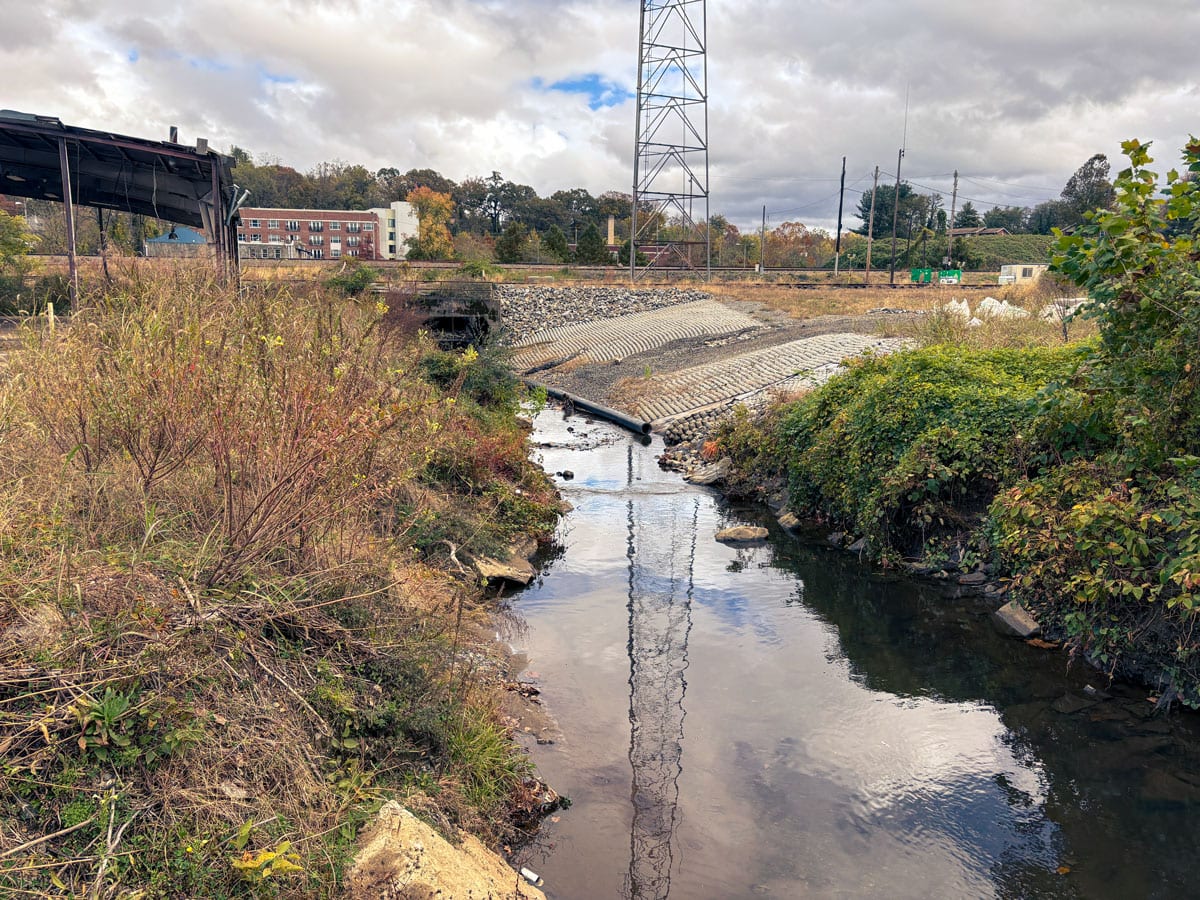
On the wooded slopes above downtown Asheville, freshwater springs converge to form what is locally known as Nasty Branch—an urban stream that flows largely underground before emerging briefly through the historic Black Southside community and the River Arts District on its way to the French Broad River. While official USGS maps label it Town Branch, local residents continue to call it Nasty Branch, a name rooted in a time when dumping raw sewage and other pollutants into waterways was common and legal. This period preceded the 1970s “Urban Renewal” program, which razed hundreds of Black-owned homes and businesses throughout neighborhoods tied closely to the stream.
In her article “I Am a Nasty Branch Kid”: Women’s Memories of Place in the Era of Asheville’s Urban Renewal, historian Sarah Judson writes that the East End-Valley Street and Southside neighborhoods—both situated along Nasty Branch—were among the most disrupted by urban renewal. She notes that the creek “functioned as a pathway through the city as it linked together several African American neighborhoods … [and] … represented an ecological connection among Black Asheville residents that transcended the mapping of city planners.”
So it is with many streams where human communities have developed. Yet despite water quality improvements over the years, Nasty Branch remains one of Buncombe County’s most polluted streams, suffering primarily from urban stormwater runoff and lack of a healthy riparian buffer. In RiverLink’s Central Asheville Watershed Restoration Plan (2020), Nasty Branch was identified—along with two additional streams—as a priority for reducing sediment and fecal coliform bacteria entering the French Broad River. Nasty Branch and 22 miles of the French Broad were officially added to North Carolina’s 303(d) list of impaired waters two years after the plan’s creation. Both streams are impaired for fecal coliform bacteria, and Nasty Branch is also impaired for its benthic macroinvertebrate community—the small organisms that indicate the biological health of a stream.
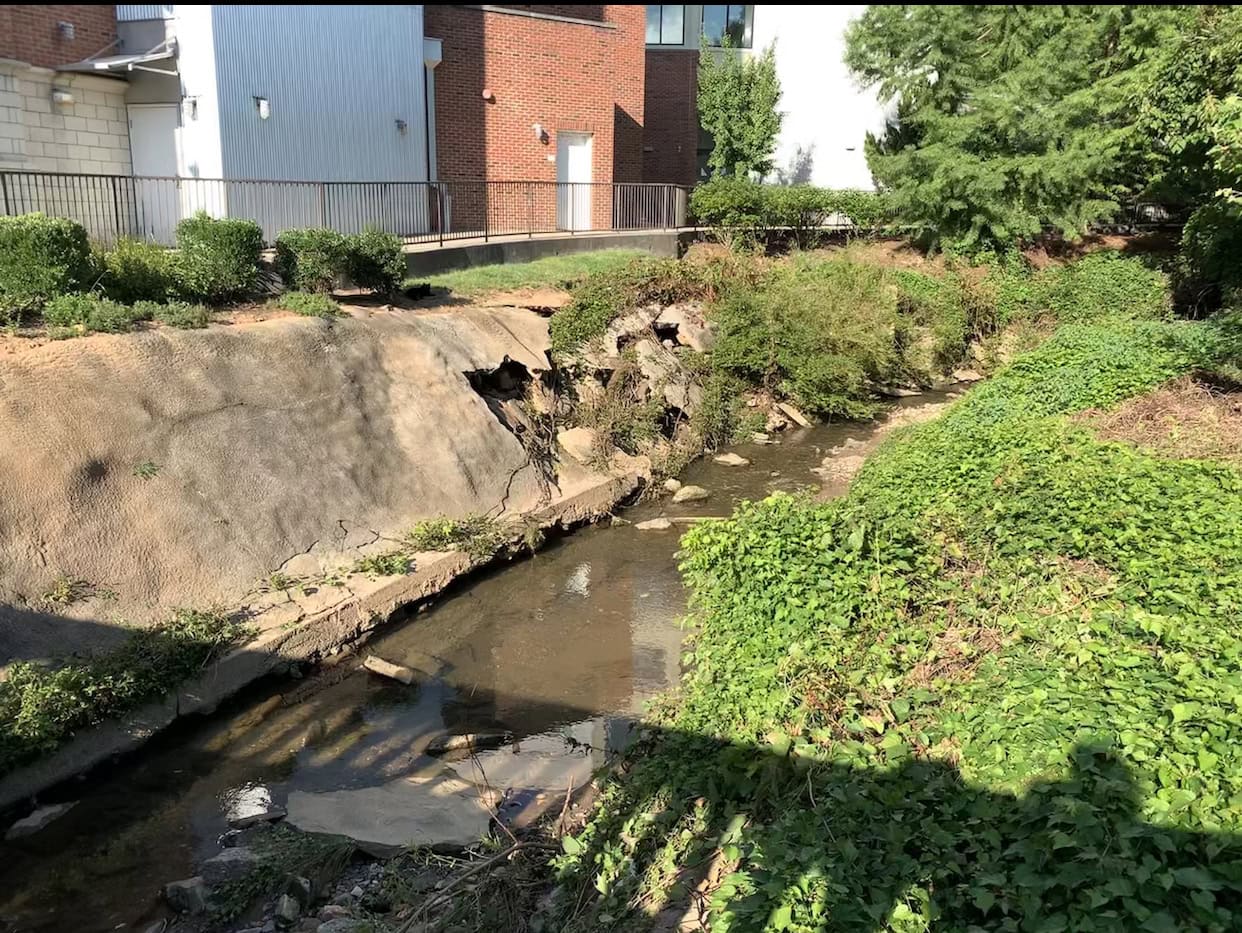
Today, in the aftermath of Tropical Storm Helene, there is a unique opportunity to collaborate with property owners along Nasty Branch as they grapple with streambank erosion, infrastructure stress, and the need for long-term resilience. Landowners have expressed interest in solutions that enhance the aesthetics and flood resilience of their properties. These goals can be achieved with the same bioengineering techniques needed to restore the ecological health of Nasty Branch. Bioengineering treatments could include replacing hard structures historically used to stabilize the streambanks (e.g. concrete) with native plants and structural materials such as logs, rocks, and geogrids. The network of roots formed by native woody plants anchor the soil in place, preventing streambank erosion, while also creating critical habitat for aquatic life.
Over the next few months, RiverLink will explore restoration opportunities on Nasty Branch in collaboration with property owners. The first step will be to complete a Basis for Design Report for restoration and flood resilience projects along the stream. This report will identify the most effective strategies, designs, and cost estimates for restoring the stream, stabilizing eroding banks, and re-establishing a healthy riparian buffer. With the state-approved Central Asheville Watershed Restoration plan in place, identified restoration projects along Nasty Branch qualify for federal EPA 319 funding. The Basis of Design Report is an essential next step that will strengthen future grant applications and accelerate long-needed restoration work along one of Asheville’s most culturally significant and environmentally challenged urban streams.
RiverLink has already leveraged more than $3 million in grants and partner contributions to implement water quality improvement projects in the Central Asheville Watershed, including our Adopt A Storm Drain program, and the DIS in the Mountains, Southside Community Stormwater and A-B Tech Green Infrastructure projects.